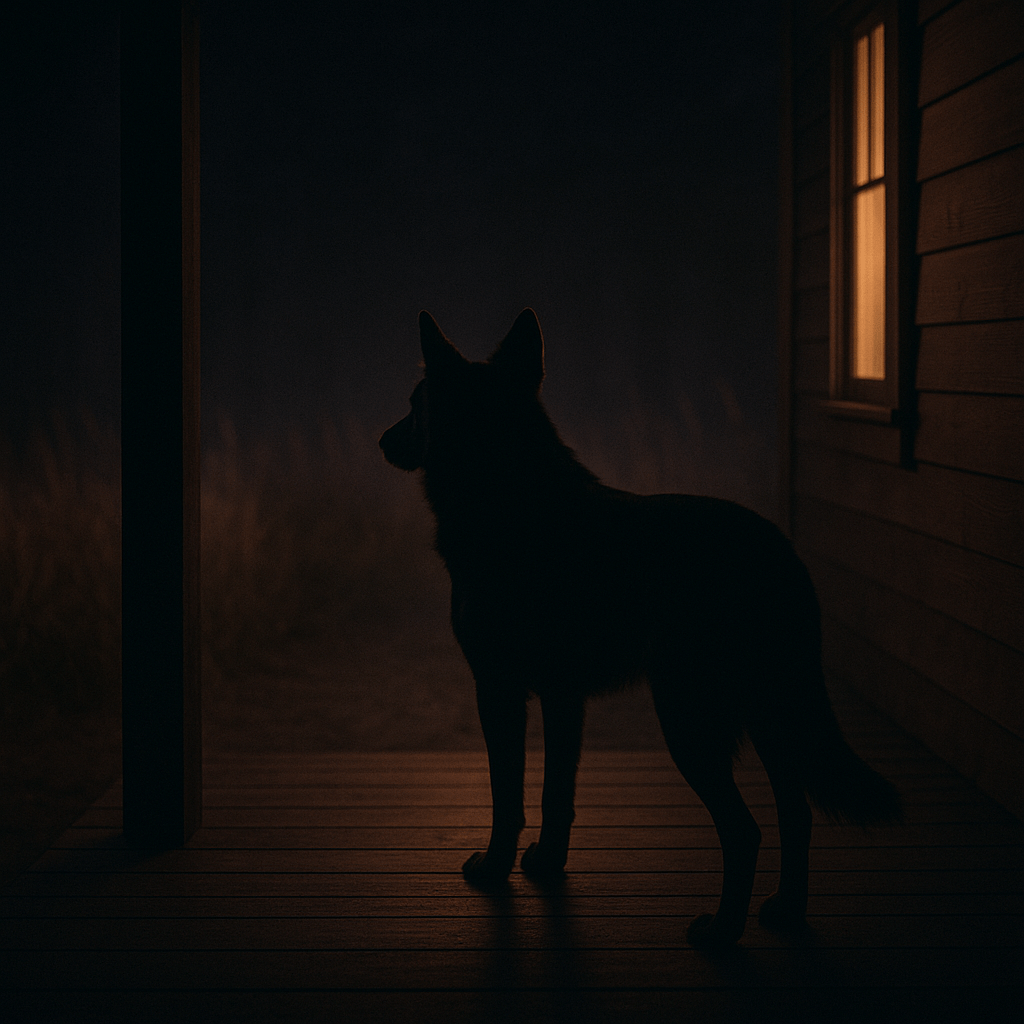
The night in Saguenay can be so still, you almost hear the frost settling on the grass. That stillness can be broken in an instant — by a sharp, sudden bark from the dog lying at the foot of your porch. You step outside, peer into the dark, and see… nothing. Not a soul.
So why do dogs bark at “nothing” at night? The truth is, they’re rarely barking at nothing at all. What seems empty to us is often alive with signals they can sense — sounds too faint, scents too far, movements too small for human senses to detect.
The Power of a Dog’s Senses
Dogs live in a richer sensory world than we do. A dog’s hearing is far sharper than ours, able to detect frequencies and distances that leave us in silence. At night, when the human world quiets down, these faint sounds — a rustle in the grass, a shifting branch, a distant howl — are even more noticeable to them.
Their noses are just as impressive. If a raccoon wandered through your yard an hour ago, your dog can still smell it. A drifting scent on the night air may be enough to put them on alert.
Wildlife Encounters
Even in towns and suburbs, wildlife is more active at night. In rural areas, like here in Saguenay, it’s common for deer, foxes, skunks, porcupines, or coyotes to pass through after dark. Dogs don’t need to see these animals to know they’re there — their senses tell them plenty.
Sometimes, they bark as a warning: I smell you, I hear you, and this is my place. Other times, it’s sheer excitement — an instinctive urge to chase or investigate.
Territorial Instincts
Dogs are natural guardians. Even the most gentle companion will often feel responsible for their home and family. At night, their protective side may sharpen, since darkness brings unknowns. Barking is their way of saying: I’m here, and I’m watching.
If the sound of footsteps on the sidewalk, a neighbor’s door closing, or a car pulling into a driveway reaches their ears, they may announce it loudly — even if it’s routine to us.
Boredom and Excess Energy
Not every nighttime bark comes from a real trigger. Dogs who haven’t had enough physical or mental exercise during the day can be more likely to bark at the slightest sound. Without a good outlet for their energy, small triggers can feel bigger.
Anxiety and Fear Triggers
For some dogs, nighttime brings unease. Darkness changes the way the world looks, smells, and sounds. Streetlights flicker, shadows shift, and familiar spaces take on new shapes. A sudden clang from a neighbor’s trash bin or the creak of a house settling in the cool air might set off an anxious bark.
When to Worry — and When to Let It Go
It’s normal for dogs to alert us. But there are signs worth noting:
- Barking goes on for several minutes without stopping.
- The dog’s body language is tense: tail stiff, pacing, ears pinned.
- Whining, howling, or frantic scratching at doors accompanies the barking.
- Barking happens every night at the same time with increasing intensity.
These can indicate anxiety, a perceived ongoing threat, or even pain or discomfort.
If the barking is brief and your dog relaxes quickly after, it’s likely just part of their nightly “check-in” routine.
How to Respond in the Moment
- Stay Calm — Dogs read our emotions. If we rush out in alarm, we may accidentally confirm to them that something is wrong.
- Investigate Gently — Step outside with them, look around, and let them sniff. If nothing is of concern, guide them back inside.
- Acknowledge, Then Redirect — A simple “Good watch” followed by a calm redirect (toy, treat, or settling cue) can teach them that the job is done.
- Avoid Punishment — Scolding for barking at night can confuse a dog, especially if they believe they’re protecting you.
Preventing Excessive Night Barking
- Daytime Exercise — A well-exercised dog is less likely to bark out of boredom.
- Mental Stimulation — Puzzle feeders, scent games, or short training sessions help settle their mind.
- Comfortable Sleeping Area — Indoors, away from drafts and noisy windows.
- White Noise or Music — Can mask faint outdoor sounds.
- Block Visual Triggers — Curtains, frosted windows, or fences can help with dogs who react to sights as well as sounds.
The Heart of It
To us, it’s “nothing.”
To a dog, it’s an entire nighttime world — scents, whispers, and movements we’ll never sense.
Sometimes, their bark is simply their way of staying connected to that world and to us. It’s worth remembering: when they bark into the dark, they might just be saying, I’m here, I’m watching, and you’re safe.
Pourquoi mon chien jappe-t-il “à rien” la nuit?
Ici, au Saguenay, les nuits peuvent être si tranquilles qu’on croirait entendre la rosée se déposer sur l’herbe. Et puis, tout à coup, cette paix est coupée net par un jappement sec de votre chien, couché au bout de la galerie. Vous sortez, vous scrutez l’obscurité… et rien. Pas un chat.
Mais la vérité, c’est que ce n’est presque jamais “rien”. Ce qui semble vide pour nous est souvent plein de signaux qu’eux perçoivent — des sons trop faibles, des odeurs trop subtiles, ou des mouvements trop loin pour nos sens humains.
Des sens bien plus fins que les nôtres
Les chiens entendent beaucoup mieux que nous. Leur ouïe capte des fréquences et des distances qui, pour nous, restent du silence. Et la nuit, quand tout se calme, le moindre froissement d’herbe ou craquement de branche devient un signal clair pour eux.
Et leur nez… c’est un roman à lui tout seul. Si un raton est passé dans votre cour il y a une heure, votre chien le sait encore. Une odeur portée par le vent peut suffire à le mettre en alerte.
La visite des bêtes sauvages
Même en ville, les animaux sauvages sortent surtout la nuit. Au Saguenay, c’est encore plus vrai : chevreuils, renards, mouffettes, porc-épics, coyotes… pas besoin de les voir pour que votre chien sache qu’ils sont là.
Certains jappent pour avertir : Je t’ai senti, je t’ai entendu, et ici c’est chez nous. D’autres, c’est l’excitation pure — l’instinct de poursuivre ou d’aller voir.
L’instinct de protéger
Même le plus doux des chiens garde un petit côté sentinelle. La nuit, ce réflexe est plus fort : moins de repères visuels, plus d’inconnues. Alors, un bruit de pas sur le trottoir, la portière d’auto du voisin, ou la porte qui claque… et c’est l’alerte.
L’ennui ou l’énergie de trop
Un chien qui n’a pas assez bougé ou réfléchi dans sa journée va réagir plus fort aux moindres stimuli. Ce qui passerait inaperçu devient, pour lui, un événement.
L’anxiété ou la peur
Pour certains chiens, la nuit change tout. Les ombres bougent, les sons portent différemment, les odeurs sont plus concentrées. Un lampadaire qui clignote, un couvercle de poubelle qui tombe, une maison qui craque… et le jappement part.
Quand s’inquiéter et quand laisser aller
Rien d’inhabituel si :
- Les jappements durent quelques secondes
- Le chien se détend rapidement après
- Il garde une posture normale, curieuse mais pas tendue
À surveiller si :
- Ça dure plusieurs minutes
- Corps raide, oreilles plaquées, pacing, ou gémissements
- Même heure chaque soir, avec intensité croissante
Comment réagir sur le moment
- Rester calme — votre émotion influence la sienne.
- Vérifier doucement — sortez, regardez, laissez-le sentir.
- Reconnaître, puis détourner — un bon chien, merci, suivi d’une redirection calme (jouet, friandise, commande).
- Éviter de punir — il croit vous protéger.
Prévenir les jappements excessifs la nuit
- Bouger le jour — un chien fatigué jappe moins par ennui.
- Stimuler l’esprit — jeux de flair, exercices courts, jouets interactifs.
- Endroit de repos confortable — à l’intérieur, loin des bruits extérieurs.
- Bruit blanc ou musique douce — masque les sons faibles.
- Limiter les déclencheurs visuels — rideaux, clôtures pleines, fenêtres givrées.
Au fond, qu’est-ce que ça veut dire?
Pour nous, c’est “rien”.
Pour eux, c’est un monde invisible — odeurs, frémissements, bruits légers qui tissent la trame de la nuit.
Parfois, leur jappement est juste leur façon de nous dire : Je suis là. Je veille. Tu peux dormir tranquille.
Reste bien au chaud,
Mélanie Gagnon, Pet Care Advisor

 The Posh Paw Blog
Lämna en kommentar